Introverts are Not Retarded or Anti-Social
Summary: The world is full of extroverts and reflects their extroverted ways. This is hard on introverts. The Dos and Don’ts of working with an introverted child.
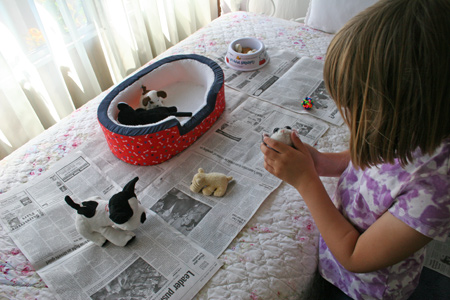
My daughter making a pet store in her room. But don't bother her while she's working on it. She'll let you know when it's done and then gladly give you a tour.
If you’re an introvert you’ve heard it all. Extroverts think you’re rude, arrogant and anti-social. They think if you just tried a bit harder you’d really love going to parties and engaging in hours of directionless conversation. They feel sorry for the way you isolate yourself. There’s clearly something wrong with you. Do you hate people? How could you be happy by yourself? Don’t you get bored just sitting in your room reading? Where’s the excitement?
Well this may come as a shock to most extroverts, but we introverts are just not that impressed with you. We also carry our own stereotypes. Your constant need for interaction and social validation comes across as shallow, desperate and needy. Your preference for small talk and your impatience with complex thoughts and feelings makes you look a bit dumb. Don’t you have any in depth opinions about anything? Do you ever reflect? Can’t you focus for two seconds and take a subject to its logical conclusion rather than just bailing as soon as it gets hard? Do actually have any close friends that you share a deep bond with or is everyone just interchangeable. Do you even care who you hang out with or will any warm body do? Do you have any standards at all?
Growing up that was my impression. Extroverts were like little puppies; spastic, needy, directionless and socially indiscriminate.
I know better now, but when you see someone constantly seeking social interaction and validation, when you see them just blab on and on about nothing, when you see them get bored when the conversation becomes more in depth and reflective in nature, it’s easy to dismiss an extrovert as being somewhat of an idiot.
Of course, they’re not idiots, it can just seem that way to an introvert. Especially when you’re young, reactionary and trapped in school.
Fortunately as you get older, you get wiser. You also have more control over your life. You tend to move away from the irritants and gravitate towards what makes you happy. So rather than slamming into each other and driving each other crazy, introverts and extroverts start socializing with each other.
Which brings me to my family.
My partner is introverted and shy but has good social skills. I am introverted but completely uninhibited and somewhat klutzy socially. My daughter is most definitely introverted and so far she she’s shy as well. Socially, unfortunately, she also seems to be a bit klutzy like her dad. I say unfortunately because accidentally offending people or confusing them by not reading or honoring social cues well is not an advantage in life. Fortunately, they are learnable through example and practice.
However, introversion is a character trait. You don’t grow out of it. It may lesson or increase overtime, but the basic predisposition will remain. It’s also unrelated to shyness, which often lessens through life. Introversion doesn’t necessarily mean you’ll also be shy. You can be both introverted and unabashedly confident. A confident introvert simply doesn’t care what you think about them, has no problem taking the lead when they feel it’s necessary, and is self-assured when dealing with other people. They just don’t require a high degree of social interaction to be happy like an extrovert.
It’s also true that you can be shy and extroverted. Shy extroverts want to be around groups and are drawn to social situations but their lack of social confidence keeps them in the background. They may go to all the parties, be on the cheerleading squad, and join all the sports teams, but they won’t be the first to raise their hand or speak up. A shy extrovert can be counted on the be a great team player, they just won’t be taking the lead.
Fortunately for those that are shy, you have the ability to gain social confidence through exposure and repetition if you choose. However, your basic introverted or extroverted nature will still be there. It’s just how you are.
The easiest way to understand introversion is that an introvert gains energy from being alone, while an extrovert gains energy from being around others.
So while grounding an extrovert is an effective punishment, grounding an introvert is almost pointless. They like being alone. Extroverts are drained by isolation, introverts are drained by socialization.
So one thing you can count on in our house is that we all need our down time. And that means alone time. Down time with others doesn’t count because being with others is draining. It takes work. So some of the happiest times in our house is when my partner’s in her room reading, I’m in my office on my computer, and my daughter is in the living room deep in her fantasy play with all her toys. We’re just fine not being with each other for a couple of hours. If our house wasn’t so small and our daughter so young, I’m sure we’d stay away from each other even more.
Now the differences between introverts and extroverts would be fine except for the fact that the world is at least 70% extrovert oriented and they have built the world to suit themselves. Extroverts have also established their traits as the norm, or more accurately normal. I have never met a parent who worries that their child socializes too much, that they raise their hands too often in class, or that they have too many friends. It seems the more extroverted you are, the more you are rewarded and praised, even if it borders on what an introvert would consider manic or desperately needy.

What is it? Well, it's a bunch of little bears examining a transparent corpse of course! Lining things up, grouping objects and creating dioramas relaxes my daughter. It's how she recharges and processes the days events.
However, worrying about your child’s disinterest in social activities seems to be a national past time. But it shouldn’t be. Introverts are just fine being alone and only having a few close friends. Parties aren’t particularly fun for them and team sports are not that attractive. They are not missing out on anything. It’s like trying to feed cheese to someone who doesn’t like cheese. You think they sit around going “gee I wish I liked cheese, I really feel like I’m missing out on all that great cheese”. Of course not. They don’t miss it because they don’t want it. This is how introverts feel about social situations. If they wanted to hang out with a dozen people at once, engage in mindless chit-chat for hours, or join a sports team they would.
This is not to say introverts are not social. It’s just that they take they’re socialization in little pieces and are more situationally sensitive. They prefer one on one interaction over groups. They prefer solo activities over team activities. This doesn’t mean introverts never hang out in groups or participate in team sports, it’s just that unlike extroverts, they don’t NEED to. And that’s an important distinction.
So don’t be confused or worried by my daughters behavior. She has a very rich and full life. She into surfing and horseback riding. She goes to the beach and the park weekly. She goes out to great restaurants and enjoys hanging out with a few close friends. But you won’t see any of that and she won’t tell you about it because she doesn’t know you and therefore she won’t be eager chit-chat with you. Even to her parents, her deep inner life isn’t fully visible. We watch and listen while she’s fully engaged in her fantasy play or working on her projects. This is where we get our clearest vision of what she’s thinking, because unlike an extrovert, she doesn’t wear her thoughts on her sleeve.
So I’ve put together a list of do’s and don’ts for dealing with my daughter. These are general tendencies and patterns. I don’t care if you follow them, I just want you to understand them.
1. Don’t put my daughter on the spot and expect her to perform.
This one is mainly for the teachers and other adults. Even after telling her first grade teacher that she was an introvert and shy, her teacher still misinterpreted her behavior as a deficiency in hearing, sight or language processing. She even recommended she be tested. Of course, her hearing and vision was fine. She was concerned that when she was asked a question there would be a delay in her response and that she would talk in soft monotone. When duh! We told her that. We even wrote it down in her profile. It is not a developmental problem. When she’s at home she’s a chatterbox, her tone is very expressive, and she can recite entire passages of her favorite movies complete with the correct character accents and inflections. But school is not home and she’s not entirely comfortable there and may never be.
2. Don’t throw my daughter into complex social situations and expect anything but silence and withdraw. At least at first.
To an introvert this is a no brainer. To an extroverted world an introvert ‘s natural response to social stress can be misinterpreted as aloofness or arrogance. It is neither. She simply feels uncomfortable and overwhelmed. It will take time and repetition for her to warm up to a group activity.
3. My daughter needs time to get used to you. Don’t take it personally if she doesn’t look you in the eye and get all excited when you address her.
Introverts need time to warm up to someone. Once they let you in, they can be quite the chatterbox and physically demonstrative. Until then though, don’t expect much. Averting the eyes and speaking in soft monotone is a normal introverted response to an overwhelming social situation. She is not being rude and it has nothing to do with how she feels about you personally.
4. My daughter recharges her batteries by being alone. Don’t take offense if she doesn’t want to play with your kid at the moment.
Children my daughter’s know her whole life will come over and ask if she wants to play. More often than not she’ll say no and go back to whatever she was doing. Especially if she just got home from school and needs alone time. If they say hi to her on the street she will respond with the weakest monotone hi you’ve ever heard. She may not even look at them in the eye. This has no relationship to how much my daughter likes your child. She’s introverted as well as bit shy and awkward socially. She simply doesn’t have the tools or predisposition to react the way you’d expect her to.
So give her a break. Introverts process internally while extroverts process externally. An introvert looks inward to find themselves and make sense of the world. An extrovert looks externally to accomplish the same thing. No big deal.
Here’s an Example of an Introverted Child in Action
We signed our daughter up for swim lesson when she was around three. The class was very small, perhaps 5 kids. She already knew how to swim, this was for learning more advanced skills. What did my daughter do the whole time? She completely ignores the teacher and the other students and played by herself around the perimeter of the action. But what do I see her doing the next day at the clubhouse pool? Practicing her ice cream scoop strokes! She was listening and observing the whole time, she just wasn’t going to practice it with the entire class there. She needed to wait until she was alone with me, in our own pool, for her to feel comfortable.
Unfortunately, the swim teacher will never see her progress.
Introverts are like Christmas presents. You don’t know what’s inside until you remove the wrapper. Some are just harder to unwrap than others.
That’s it for now.
Further Reading:
This is one of the better articles on extroverts and introverts.
I enjoyed this nice post by Hunter Nuttall about being an introvert
Check out this funny tongue-in-cheek extroverts verses introverts dictionary.
A decent article on introversion by Johnathan Raunch
And another good article by Brian Kim about what you should know about introverts
File Under: Tips for Dealing With Introverted Children – Introverts Versus Extroverts – Advice for Working With Introverted Students – Introverted Parenting – Shy Children – Dos and Don’ts When Working With an Introverted Child


December 10th, 2009 at 10:56 pm
Very in-depth article!! This contains a lot of great info. I think it’s difficult for many extroverted people to understand the ways of an introvert – but hopefully with more blogs like this – they’ll finally get it. 🙂
.-= Daisy´s lastest blog ..Where is Daisy Going?? BIG SMILES!!! =-.
[Reply]
cyncialintrovert Reply:
December 10th, 2010 at 4:13 pm
Sorry. The extroverts are at happy hour right now pouring spirits down their gullets and engaging in directionless conversation. The only time they read or do anything that doesn’t involve another human being is when there’s no one around and they’re waiting to participate in a real activity, e.g. something social. If it ain’t social, it doesn’t count.
[Reply]
Liam Reply:
June 14th, 2017 at 2:30 am
Dead fucking rite. My mom asks always why am i like that, why do i behave like that, why am i such a … why this why that.. thats coz she is always around people otherwise she gets mental on me or my dad, she just wants always to be around people. im totally fine alone and in my room. she thinks im a lazy person just coz i stay in my room. fuck’s sake this shitty family hypocrite and judgemental
[Reply]
December 11th, 2009 at 9:33 pm
Wow, great stuff here! I shared it on Twitter.
Speaking of which, am I missing something, or are you really not on Twitter? I’m sure the Twitterverse would love to have you!
Oh, and thanks for linking to my introvert post.
.-= Hunter Nuttall´s lastest blog ..Mesothelioma Lawyers, New York =-.
[Reply]
Straight Dope Dad Reply:
December 12th, 2009 at 7:16 am
You’re welcome. Your post about introverts is really quite good. Not on twitter yet as The Straight Dope Dad ( I am under my business name Claytowne) Soon though. Thanks for the tweet.
[Reply]
Vicki Brown Reply:
December 12th, 2009 at 1:12 pm
I came here via Hunter’s post in Twitter and want to second his hope that The Straight Dope Dad will start tweeting soon!
.-= Vicki Brown´s lastest blog ..vlb: Trying TweetDeck. Annoyed that it allows color customization of 4/5 of the interface! The part I really want to change remains dark grey. 🙁 =-.
[Reply]
December 26th, 2009 at 9:18 am
Outstanding post! I wish my parents were as informed about my intraversion as you are about your daughter’s personality. Its difficult living in an extravert world!
[Reply]
August 10th, 2010 at 7:17 pm
I google introvert because I have been feeling displaced lately by being one. Good to know I am just being me.
[Reply]
September 27th, 2010 at 2:45 am
Ah, I loved your quote at the end. :))
And it is good to be so protective of her and make it crystal clear to the others.
.-= Nicole Simon´s lastest blog ..Sunday is a good day to ask yourself- Are you happy at work =-.
[Reply]
Straight Dope Dad Reply:
September 27th, 2010 at 2:13 pm
Thanks.I’m quite fond of that line as well.
[Reply]
September 27th, 2010 at 3:41 am
“Of course, they’re not idiots”
Oh yes they most certainly are.
[Reply]
fhk Reply:
October 2nd, 2010 at 10:06 pm
you’re delusional if you think people that process differently than you do don’t process at all.
And a hypocrite.
[Reply]
Straight Dope Dad Reply:
October 3rd, 2010 at 5:51 am
I think he was being facetious. His signature is “allerious” after all.
[Reply]
Sienna Reply:
October 3rd, 2010 at 9:20 am
they’re not idiots. They think diffrently from you, just like you think diffrently from them. You don’t want them to judge you becuase you don’t funtion with other people in public situations, we don’t want you to judge us that we do well in public situations. Extroverts do reflect on things, just not to people who aren’t responding to the situation.
[Reply]
September 27th, 2010 at 5:15 am
Just found this through stumble. It was a very good article, very interesting.
I like reading people’s thoughts on introverts from time-to-time. Its an interesting subject to me, since really figuring out that’s more or less what I am. The descriptions of your daughter’s personality are very familiar to me, and I wish someone noticed and understood how I acted when I was younger.
[Reply]
Philliph Reply:
December 15th, 2011 at 9:55 pm
What’s particularly funny, though, is that most of the people that will read this are introverts already. So they’ll just be smiling and nodding in identification.
[Reply]
Straight Dope Dad Reply:
December 16th, 2011 at 3:40 am
I think that’s ok. Nothing wrong with preaching to the choir when your choir is so misunderstood…even by themselves sometimes.
[Reply]
September 27th, 2010 at 5:38 am
This article sums me up to a T. Online I could almost even pass as an extrovert, but put me in a room of people or even just one or two that I don’t know well and suddenly I’ve become the stuck up girl who apparently thinks she’s better then everyone. Not the case at all- people I don’t know well just make me extremely uncomfortable and I pretty much can’t function around them.
Everyone should read this article or one of the other good ones out there and get a wake-up call. We are not all the same, and we don’t process or react to things the same way either.
Great article!
.-= Throckmorton Jones´s lastest blog ..I Feel Like a Genius! =-.
[Reply]
September 27th, 2010 at 6:52 am
Stumbled upon this.. thanks for the interesting read. As an introverted male this has given me a lot of insight to myself and the world.
“So while grounding an extrovert is an effective punishment, grounding an introvert is almost pointless. They like being alone. Extroverts are drained by isolation, introverts are drained by socialization.” – Love that sentence!
[Reply]
Straight Dope Dad Reply:
September 27th, 2010 at 2:21 pm
Thanks. When my mom sent me to my room it was no big deal. That’s where all my stuff was anyway so it was hardly a punishment. One thing I forgot to mention in the article is that introverts tend to be protective of their routines. They’ve set their life up in a specific way and disrupting that is stressful. I remember always enjoying family vacation once I was actually in the thick of it, but the anticipation of going on vacation was stressful because all it meant to me was a major disruption in my life. I would rather just stay home. However, I was always glad I went after the fact. Even if I was nauseous most of the time due to my intense car sickness.
[Reply]
Patti-Ann Reply:
September 29th, 2010 at 12:18 pm
I know exactly what you mean. Even now as a 50 year old woman I still stand back and think will the fun be worth the anxiety? The answer is usually no and thankfully I don’t feel cheated when everybody comes back with a funny story because I am just fine thank you :P)
I am still astounded as your descriptions and explanations. I have been in therapy for years. I just found the reason for a lot of things I thought were problems. I may not be cured but I am happier. Thanks so much.
[Reply]
September 29th, 2010 at 12:14 pm
Wow, thank you for explaining what is wrong with the other people! I am introverted and happy and until just now confused about why people chatter about nothing. From now on I will confidently maintain my little spot of earth and observe and comment as I see fit! Really, wow and thank you so much.
[Reply]
September 30th, 2010 at 6:42 pm
Thanks for the article, posted to FB. Perhaps someone who needs it will read it. Now, that said, I feel defensive after reading your article. I’m extremelllllllly extroverted, though, I do need to re charge by myself sometimes and you sound a little prideful about being an introvert. There is no superior here, we are all equal. That said, I hope you get from your daughter’s teachers, the understanding she needs; It just doesn’t seem that difficult a concept to grasp, to me! Thanks.
[Reply]
October 1st, 2010 at 8:39 am
The title itself is what I want to say to a person who I knew is trying to gauge me and make a conclusion that there is something wrong with me. (They don’t have to tell it as we can tell.)
Sadly, even my parents who are introvert at some point feels the same way about me. (They don’t even know their character trait, so how can they understand their daughter.) Sometimes, I want to discuss this issue with them, or better yet have them read your article which help people understand and not just be aware that we exist.
Keep on spreading the word and educating parents and those who are not yet embracing the fact that they are introvert and that there’s nothing wrong with them.
.-= Clumsy Fancy´s lastest blog ..Asian Doctors Are in- Move Over Grey’s Anatomy =-.
[Reply]
October 3rd, 2010 at 9:16 am
It’s still not socailly acceptable for a child to act like that in public. It’s vital for a child to learn socail skills in order to get by in life. If a chid doesn’t respect the fact that a swim teacher is trying to teach her something and she goes off on her own it makes it difficult to keep order and make sure she is doing everything ocrrectly.
[Reply]
Straight Dope Dad Reply:
October 3rd, 2010 at 9:55 am
Well, that’s why we didn’t sign her up for another class. But you’re also mixing up what’s ideal (a child who behaves exactly the way you’d like) and what is reality (a child behaving in a way that is developmentally appropriate for their personality type and their age). For her, at that age, that was all she was capable of doing. It had nothing to do with her learning social skills or respect. It was what it was. I went through twelve years of teachers misunderstanding my personality type and my learning style. In class I drew all the time. From first grade through graduation that’s what I did. All my tests and assignments had doodles in the margins and on the back. It’s how I relaxed and processed. In the beginning of each semester there would always be a teacher or two who would try to “catch me” by calling on me while I was drawing. After a couple of times of answering their surprise questions 100% correct, they realized I was listing and learning, just not the way they expected me to. Getting straight A’s with little effort also helped them understand I had it under control. No disrespect was meant and I was a model student. If I had been forbidden to draw in class I doubt I would had made it through school as it would have been unbearable.
[Reply]
October 3rd, 2010 at 2:59 pm
Great, wise, needed, and helpful article.
[Reply]
October 4th, 2010 at 8:18 pm
I just wanted to say, this described me perfectly. I showed this article to my mother and we are getting along much better now. Thank you
[Reply]
October 4th, 2010 at 8:33 pm
I am so glad I stumbled upon this, until I read this I had no idea that people could be introverts or extroverts, and reading this made me realize that I am an introvert. Everyone and myself(until now) thought there was something wrong with me because I am not socially outgoing until I warm up to you, and I hate small talk, and my way of unwinding is to be by myself working on a personal project of some sort. I feel much better now, and will brush it off when my mom tells me how anti social I am, because I’m not the life of the party like she is. Thanks.
[Reply]
October 5th, 2010 at 4:07 pm
Introverts are Not Retarded or Anti-Social???
That title for this article indicates ignorance and is offensive. Whoever thought introverts were retarded?
Empty vessels make the most noise. A typically ignorant person would think such things.
[Reply]
Straight Dope Dad Reply:
October 6th, 2010 at 11:04 am
I don’t see how that title could possible be offensive. It’s a rejection of derogatory labels. It’s a defiant declaration that affirms ones worth. It’s the direct opposite of offensive. However, I would say that your are most definitely acting a wee bit retarded in not understanding that. Just sayin’.
[Reply]
Prospero Reply:
December 29th, 2010 at 3:02 pm
Dear Straight Dope Dad,
I was feeling sympathy towards you and even chuckling over some of your comments. But after bragging about your straight-A marks in school and now telling someone he’s acting retarded, I must say this only validates my feelings towards “Introverts”. You _do_ feel superior over other people, since you hold your perception of extraverts “blabbering about nonsense” as being true to fact. And also little comments about our inability to reflect. So basically that means that about 70% of the world is successful purely because of luck ?
Also, I personally feel you try to put to much emphasize on your intellectual capacity and your knowledge of “interestingly sounding words”. We really believe you are a intelligent human-being, please don’t try so hard to convince us…
(oh, and just in case you were planning to correct my english, it is not my native tongue. And as a reflective extravert, I do know my limitations.)
[Reply]
Straight Dope Dad Reply:
December 29th, 2010 at 4:37 pm
Fair enough.
However I was not really calling that person retarded, I was playing with the multiple meanings of the word to bring the comment full circle. It was meant as a lighthearted but smart-alecky remark.
For the record though, words are just tools and I try to use the right tool for the job. Sometimes a simple “cool” is perfect, but other times “stellar” is better. I know it seems like I try to use “big” words (and I’ve been accused of that by my peers for a very long time) but this is how I really talk and have always talked. Sometimes it’s street and sometimes it’s academic. But words are important.
Here’s the preamble of the Declaration of Independence:
We hold these truths to be self-evident, that all men are created equal, that they are endowed by their Creator with certain unalienable Rights, that among these are Life, Liberty and the pursuit of Happiness. — That to secure these rights, Governments are instituted among Men, deriving their just powers from the consent of the governed, — That whenever any Form of Government becomes destructive of these ends, it is the Right of the People to alter or to abolish it, and to institute new Government, laying its foundation on such principles and organizing its powers in such form, as to them shall seem most likely to effect their Safety and Happiness.
That’s absolutely fucking beautiful! One of the best two sentences ever written in the history of the world. It clearly articulates some very profound ideas in the shortest number of words possible. Jefferson slaved over that to get it just right because words mean something and he knew it. The last time someone wrote like that was King’s “I Have a Dream” speech. It’s not my fault that as a nation we’ve fallen so far that choosing your words carefully is seen now as showing off. Today, both of those two would be chided as elitist and out of touch with the common man, which is really sad. Our current president gets slammed for it all the time just because he chooses his words carefully and doesn’t just blurt out crap like “Rarely is the questioned asked: Is our children learning?” or “I know what I believe. I will continue to articulate what I believe and what I believe — I believe what I believe is right.” like his predecessor. I don’t care if you support his policies 100%, you should be embarrassed and ashamed when our leader can’t converse intelligently with his fellow citizens, not to mention world leaders. That is not being empathetic to the common man, that’s just being dumb. And dumbness is not a virtue.
And no, I’m not comparing myself to Jefferson or King. I’m just using these two brilliant examples to make a point. Words matter.
Thanks for kicking me in the ass though.
I also would have never guessed English was not your native language. It’s quite excellent.
October 6th, 2010 at 10:52 am
Ditto to Clair (above)…
Maybe the title could be offensive to some but the article is wonderful. I am not a young person and I have never heard myself described so well. Thank you for removing my self proclaimed label, “anti-social”.
Please check out what I do in my alone time at:
http://lizdezign.etsy.com
[Reply]
October 6th, 2010 at 1:52 pm
This is an excellent and relatable article. Shame on the teacher for not understanding introverts. Wasn’t there a couple psychology classes she had to take before she became a teacher? =\ Because there should have been, and this should have been covered.
[Reply]
Straight Dope Dad Reply:
October 6th, 2010 at 3:23 pm
I may have been a little too harsh on her (the teacher). She’s a great teacher, really proactive, and made sure our daughter got in the reading tutor program at school which was what she really needed to get her up to speed. By the end of first grade she was right on track as far as what they expect you to be able to do at the end of the year. This year she’s kicking butt, getting perfect scores on all of her spelling tests, and finishing all her work on time. However, when I wrote the article I was frustrated of having to explain her behavior over and over again. Everyone get’s it now though. so we’re all on the same page.
[Reply]
October 6th, 2010 at 3:14 pm
I’d be offended by the article, but being an extrovert I got kinda distracted half way through.
What I will say is that maybe next time yo……
[Reply]
Straight Dope Dad Reply:
October 6th, 2010 at 3:25 pm
Good one. But I’ll need an hour of alone time to reflect on your joke to determine if it’s truly funny, or I’m merely reacting on a superficial visceral level.
[Reply]
October 6th, 2010 at 3:55 pm
Great article! My boyfriend is an extrovert, charming.. has all the social skills required, and I am an introvert, but not socially awkward.
He always wonders why I’d just prefer to hang out with him, and why I’m chatty, playful and outgoing with him and the few close friends I have and pretty withdrawn from regular social interactions.
I am really goofy and (holy jeez) fun, but when I’m stuck in situations like dinner parties with acquaintances I feel I have to put on an act just to appear “normal,” and engage in boring small talk about Lady Gaga and the newest fashions.. which is why I like to avoid those situations in general.
I’ve been labeled as stuck-up or even stupid (most of my boyfriend’s friends don’t take me seriously) because I rarely contribute while I’m just listening. I don’t have an interest in the subject (It’s cool if you do), but if they want to talk about it, I’ll listen. If you start talking about something I’m truly interested in (and I’m comfortable), I contribute and will even argue my point haha 😛
I also had that same issue in high school, where I would miss a day a week if not more, doodle all the time in class, but I had straight A’s and could answer every question thrown at me correctly.
Awesome article, I hope extroverts will read it and give us a break 😛
[Reply]
October 6th, 2010 at 4:58 pm
This was one of the most personally biased articles I’ve ever read. I’m glad I read it and I can see where you’re coming from, but the whole tone of it sounds like “The big bad extrovert world out there is ganging up on us select few introverts, when in fact we’re better because we can do things like think in depth and have genuine close friends.” Where are you getting these facts? You imply that extroverts have all these needs that introverts do not which is just not true – introverts need to be alone! You make extrovert this pejorative term which it is not. You also fail to mention that there aren’t just introverts and extroverts, but there’s actually a spectrum. I think I lie, as you can tell by my reaction, to the extroverted side but I definitely have very close friends that I have in depth conversations with, I don’t see everyone as interchangeable and I don’t like small-talk. I still go to and enjoy parties though. Why? because I get to meet people and if that requires having “mindless chit-chat” with a bunch of people until you find someone who you have an interesting conversation with then so be it. That’s a question of maturity and not social predisposition. I also enjoy my alone time but not ALL THE TIME. Being too much of either is bad, but you imply that being too introverted is better than being too extroverted. If you NEED to be on your own the whole time in order to function and will only EVER interact socially with those you know well, you will never experience new situations, you may never discover things that you didn’t know you liked and you will never meet new people who, for all you know, could be your closest friends. Similarly if you can only function when you are around other people, you will have little personal investment in anything and you will simply be a shallow product of others around you.
And btw, someone who changes topic when a conversation gets interesting is called a bimbo, not an extrovert.
[Reply]
Straight Dope Dad Reply:
October 6th, 2010 at 8:09 pm
Well of course it’s biased. It’s somewhat of a manifesto. I thought that was pretty obvious by the title. This is my point of view and it’s based upon me and my family and a lifetime of being an introvert in an extrovert’s world.
However, I think you misunderstood my point in the beginning. In the beginning I contrast prejudices that both introverts and extroverts have about each other and how these prejudices are based on our experiences and magnified through our personality types. I also didn’t make them up. This is how we experience each other and the general feelings we walk away with from these experiences.
Is their an introvert/extrovert spectrum? Yes. But this is not a scholarly article. It’s a personal journal.
Could I write a really great, balanced thesis on this from an impartial and impersonal perspective? Probably, but it would not empower anyone and be a chore to read.
You also wouldn’t have taken the time to read it and then respond with such a well thought out and articulated comment if it was an academic essay. So although you disagree and some points I’d say I accomplished my goal which was to empower introverts and provide a clear set of talking points on how the introvert’s mind works.
[Reply]
October 6th, 2010 at 4:59 pm
my entire family is this way with 2 being a bit more profound and those 2 are slightly autistic. My son being one of the autistic ones.
[Reply]
October 7th, 2010 at 4:04 am
This describes myself, husband and daughter perfectly. The part that really stuck out was how your daughter could recite lines from her favorite movies with the right inflection and timing, etc… My 3 yr old is the same way. She’ll talk our ears off at home, but once another person- especially a child- that she hasn’t interacted with since birth is thrown into the equation she clams up. I’ve always had social anxiety, and I can see some of that coming through with her. I’m currently 38 weeks pregnant with my 2nd daughter, so it will be interesting to see if we add another introvert to the family.
[Reply]
October 7th, 2010 at 11:34 pm
“A confident introvert simply doesn’t care what you think about them, has no problem taking the lead when they feel it’s necessary, and is self-assured when dealing with other people.”
I knew that I’m an introvert, but I could never figure out why I’m also rather outgoing. (I was a terribly shy child.) I used to worry about what other people thought, now I just barely care. I still like time to myself the best, though.
It’s true about how extraverts perceive introverts. I have an aunt who thought that I was “stuck up” when I was little because I was quiet. The truth is I was afraid of what she might do in response to things that I did, thus I did nothing.
[Reply]
Straight Dope Dad Reply:
October 8th, 2010 at 5:27 am
Yeah, being a confident introvert is an interesting pairing. I wrote that because it’s me. I can give a speech in front of 500 people, do stand up comedy, play a packed house with my band, organize a political rally, talk to the press – without being self conscious. However, these things do not energize me. They are draining. I only do it because it’s part of a larger goal (usually based around communicating an idea or changing something I don’t like) and it comes with the program. But after the event is over I’m spent. So the thrill for me is not the process (highly charged interaction with many people) but the result (accomplishing my goal).
However, an extrovert in the same situation would be super charged afterwords and want to keep the party going. It’s like fuel for them.
And yes, it really is true that extroverts see us this way (and no, not every single one of them on the planet, I’m talking in generalities here).
I didn’t make up those insults, I was told every single one of them to my face and apparently many introverts experience the same thing. Of course, when we try to explain the situation, many extroverts tells us to stop whining, stop making something out of nothing, and just get over it. Why do you have to be such a downer? Which of course, besides being righteously ironic, is very easy to say when you are the one dishing it out;)
[Reply]
Dawnelle Reply:
October 10th, 2010 at 1:00 pm
Yeah. Luckily we barely care what they all think, lol. For the most part I’ve learned to humour introverts when the occasion calls for it, and the rest of the time I just do my own thing. It seems like the most needy extroverts all have slipped from my life over the years, much like the only plants left in my house are the hardy ones that can tolerate my irratic watering patterns.
But it really is interesting. Good article.
[Reply]
October 9th, 2010 at 11:27 pm
I gotta say I enjoyed this. I’m 17, a senior in high school and definitely an introvert. I’ve been having problems with one of my friends who is a total extrovert. She wants me on the phone all the time, every day and it wears me out. I’ve told her how I come home tired and I like to relax by getting on the computer, writing, or something and she takes it as I just don’t want to talk to her.
A word of advice to extroverts: Introverts can get very frustrated and angry just like you.
[Reply]
Dawnelle Reply:
October 10th, 2010 at 12:54 pm
One of my friends is like that. She spends every day running around at baby dates and coffee and visiting and all manner of social activity. Honestly, sometimes just listening to her list is horribly exhausting. It amazes me, but she still has time to be irritated if I neglect her. She just seems unable to understand that after work (and on days off, lol) I much prefer to be alone. I think she takes it personally. I’ve explained repeatedly but she does not get it.
So in the past I would realize that my friend was getting annoyed with me, so I would feel irritated that she was irritated and avoid dealing with it. Which just made it worse.
Lately I’ve gotten in the habit of putting in just enough time to keep her bitterness down to a minimal. It’s a nice balance. She doesn’t get hurt feelings, and I get to not be bothered.
When I don’t feel like a complete hermit I usually suggest a movie to my social friend. It works well, especially when it’s not a popular movie so the theater is pretty empty.
[Reply]
October 14th, 2010 at 6:43 pm
Thank you very much for this post!
I’m an introvert and during my childhood was often “encouraged” to come out of my shell, if you will. I was put through language therapies and was nearly diagnosed with autism. Doctors did label me as “retarded” (despite being relatively far ahead of my classmates academically)
I identify with a huge amount of what you’ve said here, the swimming lessons (and, as read in some of your comments, the doodling in class!) and expectations of performance for others especially. I love singing, but I hate to perform for others, even if they can only hear through the walls! However, it often comes up in that oh-so-dreaded “small talk” that I can sing, so automatically I get asked to deliver. When I tell them I don’t feel comfortable doing it, I often get called “boring”, “selfish” or “stuck-up” – some of my more extroverted family members telling me that paying for my lessons was a “waste”, despite the obvious joy it gave me. It’s often easy to feel very pressured and, frankly, upset because of these things.
I’m really glad I found this article – I feel that knowing that it’s just the way I’m perceived by extroverts, and not a flaw in my personality as I feel pressured to believe, I can take the comments on the chin a lot more 🙂
Thanks 😀
(ps. I think your daughter’s really lucky having such an understanding family!)
[Reply]
October 14th, 2010 at 6:56 pm
http://www.capt.org/mbti-assessment/estimated-frequencies.htm
I stumbled upon this post and showed it to my friend who is really interested in psychology. He showed me this graph, telling me that introverts actually outnumber extroverts in the US now!
I think this is awesome 😀
/is also introverted
[Reply]
Straight Dope Dad Reply:
October 14th, 2010 at 7:14 pm
I found some similar statistics as well recently. I may have to revise my article to say “although the population is about evenly divided among introverts and extroverts, the extroverts, by their nature, tend to dominate and set the standards on social behavior.” Which is probably more accurate but expresses the same dilemma.
[Reply]
October 16th, 2010 at 9:25 am
My husband is an introvert and as a child he was misdiagnosed with autism. I am an introvert, too, but my job requires me to maintain social network, frequent social events, and ‘learn’ behaviors which otherwise would have been acquired naturally by the extroverts. I strongly agree that we should have respect for others’ territory, regardless of whether we are dealing with an introvert or an extrovert. It’s true that introverts do not need a lot of social interaction, however, some introverts may benefit from training themselves towards a few extroverted behaviors as this might improve interpersonal relationship. There are many occasions when we have to interact/relate to people to whom we’re not close to and be genuine about it. In addition not ALL extroverts have misconception about introverts. I have a lot of friends who are extroverts and I could see that their experiences with different types of people has taught them how to emphatize with others and be respectful of boundaries. Extroversion isn’t necessarilly synonymous to shallowness or pursuit of social validity. They just love to interact and always be surrounded by others for a reason I myself may not completely understand. I don’t think it’s a problem as long as we can accommodate to what each other lacks.
[Reply]
October 17th, 2010 at 2:57 pm
Insightful article. However, I’m not sure that everyone conforms so precisely to one or the other personality type. I guess it’s this need in us to label and put ourselves in neat little boxes. Ironically I guess an introvert feels as if they ‘belong’ to part of a community by labeling themselves as such. I think the introvertion/extrovertian spectrum is wide and we all fall somewhere along it, highly dependent on a given environment or situation. Sometimes I can be not at all shy and extroverted, other times painfully shy and introverted. Just my experience.
[Reply]
October 18th, 2010 at 10:22 am
Thank you, thank you for this post! This is sooooo my son! He’s four and has already been “labeled” as needing additional assistance from the first daycare he was in. He was 6 months old at the time and they felt it wasn’t social enough, wanted to be held too much, might have a learning disability, etc. His current school is wonderful and they have embraced the thoughts mentioned in your post. And he has thrived! Thank you.
[Reply]
October 19th, 2010 at 11:59 am
Good read!
I’ll second the comment that most people probably don’t (and need not try) to fit neatly into definition as an introverted , extroverted, shy or outgoing person, but I don’t think that would be news to the author.
The thing in school that always bothered me as someone who leans heavily toward the introverted side of things is “class participation.” All through high school and college I’ve had to deal with teachers and professors defining class participation as being outspoken and social in class and even assigning a grade for it.
I once received a B- in a college course after receiving A’s or A-‘s on every single paper and assignment. On most of these papers the professor even commented that my work was excellent, thought-provoking, creative, etc… But 20% of the class grade was “class participation” and I didn’t speak in class. She insisted that I should, as I clearly had good ideas.
What my professor and many of her colleges didn’t understand is that I was participating in every lecture and class discussion. Speaking to groups of people isn’t the way I participate. Honestly, I felt that reflecting on class material in a creative and thought-provoking way on assignments and papers reflected a deeper level of “class participation” than that which was outlined in the class syllabus.
I suppose extroverts may be more interested in teaching than introverts, but I wonder what would happen if Professor Me insisted on class thinking periods between lecture topics… And yes, talking during these lectures would be reflected in a low “class participation” grade. We’re trying to think here.
[Reply]
Straight Dope Dad Reply:
October 19th, 2010 at 12:08 pm
Funny anology! And thanks for assuming what I thought everyone would assume – yes, there is a spectrum. and we’re all much too complex to fit so nicely into one simple category, but it would be impossible to even have a conversation about this if every statement was preceded by, and diluted by, a disclaimer or caveat.
[Reply]
Kevin Reply:
October 26th, 2010 at 3:09 pm
Haha, dreaded class participation…the Achilles heel of many bright introverts. I think I fall into the “don’t care what others think” category the author talked about, but during undergrad i tended to lay low the first few weeks until I got a feel for my classmates and the prof. and felt more comfortable around them. Starting law school a few months ago I was forced to adapt a new strategy quickly because speaking passively and being unable to fully express ideas is a quick way to get a reputation as dumb when getting cold called in front of 100 people. It wasn’t too much of a problem and I imagine there are plenty of extroverts that got just as nervous as me, if not more, when getting called upon. Something that I kept hoping would be mentioned in the article was the use by many people of introversion as an excuse for social anxiety, though this issue probably deserves an article of its own. I imagine this disorder is more common in introverts, but I think it’s important for individuals to be honest with themselves about which category they fall in. It’s fine to be an introvert, but humans are social creatures and inability to properly engage with others will prevent people from reaching their potential.
[Reply]
October 22nd, 2010 at 10:21 pm
I wish my parents knew this when I was growing up. I’m in college now and people give me weird looks when I chose to stay in my room alone instead of hanging out with everyone else. The problem with being an introvert is people tend to overlook you easier and not want to spend the time getting to know you.
Also, I worked at a day camp last summer and this one girl almost always played alone. My division leader would always tell me and my co-counselor to try and get her to play with other girls more. The thing was, she did have friends! Especially this one girl in a different group. They always played together all of swim, but because she wasn’t friends with the majority of the group she was in, that meant something was “wrong” and we had to “fix” it. It’s one thing if a kid has no friends, but when they clearly have friends, just let them do what they want. None of the kids were exclusive and if she asked them to play they would have had no issues with it.
[Reply]
Straight Dope Dad Reply:
October 26th, 2010 at 11:18 am
I agree. All my childhood I had one best friend and then maybe two or three secondaries. But the vast majority of my social time was one-on-one with my best friend unless it was the usual “let’s all roam the neighborhood and cause trouble, play war, throw rocks, play tag, trespass, roam the alleys looking for cool garbage, build a fort, shoot hoops, etc.” situation when all the boys just kind of showed up in the streets. I’m still that way. Though my circle of friends has grown with age and experience, I can only maintain a very limited number of meaningful, ongoing connections at one time. So though I have more people than ever that I’m close to and can honestly count as a good friend, I can only sustain regular interaction with a few at a time. So I kind of rotate them. I simply don’t have the mental ability to handle them all at once.
[Reply]
October 23rd, 2010 at 3:19 pm
Wow, I thought I was the only one who is happier in front of the t.v. than trying to figure out what to say or when we can leave a party. Don’t get me started on the moms that gab nonstop. I don’t care about every last detail of your kid any more than you care about mine. One mother was prattling on at open house and then muttered, “Oh, Johnny isn’t in honors science this year”. One second later the teacher said, “Welcome to honors science”. I haven’t finished your article or the comments, but was compelled to thank you and offfer my two cents.
[Reply]
October 26th, 2010 at 2:56 pm
Overall a pretty good examination of what it’s like to be an introvert and the perceived inadequacies of introverts by extroverts. However, just as you accuse extroverts of misinterpreting introverted behavior, you are quick to judge the behaviors of extroverts. You make a good point about the world being geared towards extroverts and introversion being viewed as disadvantage (which due to the nature of extroverts seems to be somewhat inevitable). As an introvert myself I agree with your perspective, but I think the attacks on extroverts is going to cause the extroverts reading the article to become defensive and as a result less receptive to the introverts perspective. Just as you want them to understand our point of view, you must concede that you don’t fully understand theirs. Perhaps by using a more passive voice (even though this is usually a literary no no) when addressing your perception of extroverts they would be more likely to be receptive. By harshly pointing out all the problems with extroverts, they are likely to respond by putting a negative spin on the logic behind introverted behavior. Hopefully some productive criticism from one introvert to another…
[Reply]
Indigo Reply:
November 5th, 2010 at 9:21 pm
I am an extrovert. I found this article to be very enlightening. It never occurred to me that my comfort with speaking up in class, joking in a crowd, etc. would be seen in such a way. Don’t get me wrong. I was not at all offended–I did recognize the nature of Straight Dope Dad’s description of we extroverts as personal and reactive, but a real experience. By having a mirror essentially held up to me (by virtue of the comparison to introverts), it is interesting to wonder how much of my extroversion IS based in a flavor of neediness. We all have neediness to a degree, it’s just interesting to be offered an opportunity to examine the degree of it–to see one’s self more clearly. Additionally, a great chance to understand the introverts around me–I really did need this information. It helps me be a better member of my communities.
Great article, Straight Dope Dad!
[Reply]
Straight Dope Dad Reply:
November 6th, 2010 at 5:20 am
Thanks for backing me on this one. I thought I was clear that I was using stereotypes and common perceptions that intoverts and extroverts BOTH have about each other as a way of starting a discussion about the subject from an introverts point of view. I never claimed that introverts were actually rude, arrogant and anti-social or that extroverts were actually shallow, desperate and needy. I was just pointing out that these are common misperceptions we have about each other, especially when we are young, which is where these misperceptions can do the most damage.
[Reply]
October 27th, 2010 at 10:57 am
hi,
i was forced into introvert situations as a small child, and grew up thinking i was an introvert. I do gain energy from being alone, but because we do live in an extrovert world, i do think you should push your daughter to be more expressive and less fearful of others. Or else, she will blame you for it in the end. Home cant always be the shelter to run away from the world.
[Reply]
Straight Dope Dad Reply:
October 27th, 2010 at 11:31 am
Um, you are an introvert. That’s the classic definition – getting energized by being alone. Also there is no such thing as being in an introverted situation. I assume you must mean forced isolation. Introversion is a trait, not a situation. I think you’re also confusing shyness, social anxiety, and social awkwardness with introversion. And believe me, if you think you’re going to “cure” introversion by forcing your kid into situations that they can’t handle, or are far past their capacity developmentally, you’re making a huge mistake.
Lastly, home is supposed to be a place to take shelter from the world. That’s the whole point of having a home. That’s why we have locks on our doors and it’s perfectly legal to shoot someone dead who breaks into it. Otherwise why not just be homeless and take you chances and hope some punks don’t roll you or set you on fire?
Sorry to be so harsh but I’m tired of well intentioned people thinking my daughter is the way she is because we coddle her or have built a bubble around her.
Believe me, she’s been exposed to more things than most adults have. She’s been to Vegas twice, Santa Monica three times, Arizona twice, has season passes to the boardwalk, visited just about every fun family thing you can do in the Bay Area. She’s tried surfing, did horseback lessons for a year and half, and attended a toddler program before entering preschool. She was also socializing with other babies in a mom’s group my partner organized.
And you know what, she cried ever day we dropped her off at the toddler program, and almost every day through two years of preschool. When she went to Kindergarten she cried “don’t go” for a full week.
When my mom would babysit for date nights she would cry when we left – every Saturday for nearly two straight years! This is grandma we’re talking about, someone she adores.
Now here’s the kicker. When we would pick her up from preschool, or come back from date night, she was happy as a clam and no hurry to go back home or have grandma leave. It was the transition that was so difficult for her.
This is how she is. Her separation anxiety and her “stranger danger” issues were apparent very early on and in full force months before the other children developed those abilities. If it was a trait that we, as a society, placed a premium on, we would say she was “gifted” or “exceptional”. But we don’t, and for good reason. It’s a real drag to have to deal with and takes an emotional toll on the parents and the child.
She’s becoming more confident everyday but she was born this way and there is nothing to fix because there is nothing wrong with her. It’s just how she is.
So that’s my companion rant to this essay 😉
[Reply]
October 29th, 2010 at 6:23 pm
As a introvert all I can say for now is that this is so spot on I read it twice and almost cried. People and minds are so interesting. Maybe this is a hint of what I should be studying. Again thank you very much the article was perfect.
[Reply]
November 1st, 2010 at 12:08 pm
As someone in the middle, I see both sides of the story. I like to be left alone and re energize in my own thoughts. However I need to be around people occasionally.
As someone who helps teach a 5th grade class my job is to balance them out. Just as I make my extroverted student have quiet, alone time; I occasionally pick out the quiet students to answer in class.
I personally believe that both aspect of the personality need to be “encouraged”. Students or future employees will need to be able to answer a random boss popping up in their office. They also will have to deal with a world not willing to wait on them to reflect. The same it true with extroverts they need to be able to sit back, reflect and make decisions of their own mind rather than group mentality. I respect each student for their own “type” yet again it should be encouraged to branch out.
[Reply]
An introvert married to an extrovert Reply:
November 3rd, 2010 at 1:57 pm
Good for you Middle Ground. You are one of the few….I’ve experienced and witnessed exactly what was stated in the article. The one refuses to see the world through the others eyes (I’m referring to both directions with that statement). Like you indicate, neither is right or wrong. If everyone could just understand that we are all different and that is not only okay, but a good thing – we wouldn’t need articles like this one…
[Reply]
Straight Dope Dad Reply:
November 3rd, 2010 at 2:08 pm
You sound like a good teacher. We need more of you.
[Reply]
November 3rd, 2010 at 2:13 pm
I have to agree with Dustin on this one. I was told my son has Oppositional Defiance Disorder when he was in the 2nd grade because of his unwillingness to “get along” with the other students, participate in class, etc. Due to some behavior issues that presented themselves last summer, it was advised I take him for testing just to make sure there was nothing else going on. It was discovered (at the age of 14 years) that my son has Aspergers. I was relieved because now I can understand why he is the way he is and why he does the things he does. He is now in Group Therapy and is a different kid. He is learning how to function in this crazy world of extroverts.
If nothing else, please look into the techniques developed for raising a child with Aspergers. It is pretty much an extreme case of introversion after all and therefore you can benefit from using the same techniques.
This advise is not only coming from experience with my son, but also because I am an extreme introvert (and was much like how you describe your daughter above when I was a child) I recently came to realize that I have a high possibility of having Aspergers myself. I find comfort in this because I no longer feel odd or like I’m not doing enough to fit in. I realize it’s just who I am. And I’m proud of who I am!
[Reply]
Straight Dope Dad Reply:
November 3rd, 2010 at 3:29 pm
I deleted Dustin’s comments (all three) because he was rude, insulting, and obsessed with arm chair diagnosis of Asperger’s – in apparently everyone. Our daughter absolutely doesn’t have Asperger’s.
However, she has two classmates that have Asperger’s. I’ve been around them both quite a bit and yes, their vibe is radically different than the other students. You notice it within seconds. That’s not a value statement either way. I think they are both fun to be around, but they are clearly operating in a different universe. The rest of the kids are cool with it because in our school, the children are integrated as much as possible and these things are discussed openly, so it’s not treated as an affliction. It’s just how they are. I’ve also had to deal with Asperger’s spectrum behavior from another person my whole life. So I know what it is, and isn’t, and I don’t need to test her for it anymore than I need to test her for blindness.
My daughter is a model student. Gets along well, follows directions well, is pleasant to be around, doesn’t hit, bite, or scratch, doesn’t act out, etc. She interests are wide and varied and not narrow and obsessive. She can read emotions properly, understands sarcasm and irony, and has a really good sense of humor.
She’s just introverted, a bit shy and a bit clutzy socially.
I sympathize with you and your son. It’s unfortunate that he didn’t get the proper help he needed earlier (and even worse, labeled with a catch-all “we don’t know how to handle you” diagnosis of Oppositional Defiance Disorder).
Fortunately he has it now and it’s never too late. Some people don’t get the proper support until they are in their fourties.
But no, my daughter doesn’t have Asperger’s.
Believe me, I’m the last person who would be in denial or feel ashamed about who their child is.
[Reply]
Dustin Reply:
November 3rd, 2010 at 5:08 pm
I apologize for any trouble I may have caused. Just understand that Dr. Tony Attwood said that women can grow up and never be diagnosed because they can “mask their symptoms” better than boys but she could very well be an Aspie. The fact you refuse a diagnosis is unfair to her as she will likely be outcasted for being “different” when she’s older.
I do want to correct one thing you said – “My daughter is a model student. Gets along well, follows directions well, is pleasant to be around, doesn’t hit, bite, or scratch, doesn’t act out, etc. She interests are wide and varied and not narrow and obsessive. She can read emotions properly, understands sarcasm and irony, and has a really good sense of humor.” – I’m exactly like your daughter and here I am a 28 year old Aspie. A lot of the things you described is “low functioning Autism” not “high functioning Asperger’s Syndrome”… Don’t let your emotions cloud your judgment…
Again, I don’t want to create any problems for you and your website (it’s a great blog by the way) but to write a complete article about your personal experience like it’s science and then disregard REAL science as fact is absurd.
Be a good father and raise an eye brow; other children don’t act this way. Your daughter is BRILLIANT and even GIFTED yet she is also socially withdrawn because of her realizing that she can’t understand other people the same as everyone else can.
My son is an Aspie as well. It runs in families. I’m having a hard time determining if my mother or my father is the Aspie that passed it to me but I lean more towards my father.
I hope that you don’t feel offended, my comments are meant as helpfulness and I have pure intentions. I’ve spent the last 6 months researching introversion and Asperger’s Syndrome; I know the science behind it and honestly can say I know what I’m talking about.
I wish you well.
[Reply]
Straight Dope Dad Reply:
November 4th, 2010 at 4:55 am
I’m giving you one more chance Dustin.
I’m happy that you have a diagnosis that brings you comfort. And I totally understand your enthusiasm in finding other Asperger’s people. I see that with people who discover they are allergic to gluten. They’re so excited to have finally figured it out, and now feel so much healthier, that they start to see gluten allergies in all their friends. Got the sniffles? It’s gluten! Tired today? It’s gluten!! Your head itches? It’s gluten!!!
My daughter is not BRILLIANT or GIFTED. She’s just a kid trying to figure out life. And like all kids she’s got her moments where you cheer and hi-five your partner, and other where you just scratch your head and wonder if she’ll ever hold a job. But that’s what young children are like. They are all over the map. If they weren’t, they’d be adults.
I’m going to say this once and then diagnosing my daughter for Asperger’s is over. Done. Anyone else that comments on it will be booted.
In kindergarten we were starting to notice things that seemed to be related to processing. We actually noticed it for years, it’s just in school it became more obvious. In first grade, with the help of her teacher we got her involved in a program to help kids that may have other issues besides the normal learning difficulties. We had a several group meetings with her teacher, the principal, the school psychologist and the developmental specialists. They ran all kinds of tests over the following weeks which we all reviewed and discussed. At no point was any Autism spectrum condition suspected or discovered because it was obvious to all involved that she that that wasn’t the issue. We got her in a reading tutor program and her teacher modified her approach a bit in the classroom with her.
This year she’s kicking butt. She tested at end of second grade level for reading in the beginning of the year, she aces all her spelling test, and her class participation is way up. She’s just more relaxed and confident all around.
So what was the issue? Nothing really. She’s just shy, introverted, a bit clutzy in the social realm and a late bloomer. Which is what we’ve know since she was a toddler.
I know you are convinced your are surrounded by high functioning Aspie’s – a very questionable condition and pointless diagnosis as it pretty much describes the entire world. Much like labeling social drinking as pre-alcholism – but you aren’t surrounded and you need to back off or YOU will be the one who is outcast, not my daughter who knows to mind her own business.
That’s it, conversation closed.
November 3rd, 2010 at 4:10 pm
Great insights here, you’ve just reinforced some traits that I was trying to run from. It particularly became a problem for me because I actually cared what people thought of me & my social skills or their lack thereof and confidence was definitely lacking. That has since started to wear off with age, my reflection time is really prized…I’m not particularly keen on nights out or parties – too hectic. If I do go out I insist on remaining with the people I came with, I have a few strong friendships but they are well maintained. I dont usually distribute my opinion when its not been solicited for but many times I’ve been silently right! I’m quite confident doing things in a prearranged way, confident speaking in front of large crowds so Im glad I’m not crazy. Of course I’ve had to learn to be socially receptive of other people even in the most daunting situations but in the end we are what we are. Great work again!
[Reply]
November 27th, 2010 at 8:15 am
I found this blog post via StumbleUpon last month, and I think it may be one of the best things I’ve ever come across on the Internet.
This might sound quite silly, but reading this blog post pretty much saved my relationship with my boyfriend. It sounds completely crazy to credit a blog post about raising a young child with that feat, but it really is true. As soon as I read it, I suddenly realized all the problems we were having, and all things I was both subconsciously and consciously blaming him for, were due to assumptions I (an introvert) was making about him (definitely an extrovert) and the way he lived his life. Everything, from his lack of focus, his apparent dislike for my analytical nature, the way he constantly socialized with everyone indiscriminately and then expected me to believe I was special somehow…all of it. Everything you wrote down. I was thinking it. And I assumed he did things that way because there was something wrong with him.
And maybe I just didn’t know myself very well, but a lot of what you wrote about growing up as an introvert hit home for me as well. I guess I had dismissed a lot of things that come naturally to introverted people as “abnormal” or “wrong” or “something I’d grow out of eventually” without realizing it. I really did think if I tried hard enough someday I would like going to parties, or having lots of friends, or getting drunk out of my mind and spending hours talking to strangers about nothing. When in point of fact, after a long day, I’m more liable to read a book or take a nap than go out and get hammered…even if I felt guilty about it along the way.
But as soon as I read your post, things finally fell into place, both about myself and my relationship. I was able to realize that the way he did things wasn’t wrong, just like the way I did things wasn’t wrong. I wasn’t shy or socially inept or broken in any way, and even though the way he socializes with people completely baffled me, it didn’t mean he loved me any less. Neither of us were wrong…just different. Subconsciously, I think I knew that, but until someone said it “out loud”, I couldn’t quite pin down what I was thinking. Eventually, I might have realized it on my own, but who knows how long that could have taken, and I strongly suspect things would have gone very badly between me and my boyfriend during the interim.
So, in short, thank you. I love your blog. I’m glad I found it. Your writing style is sharp and enjoyable, and your subject matter is obviously quite thought provoking. 🙂 You helped me clear up issues I didn’t even realize I had. And, you’ve helped me open up the lines of communication and save a really wonderful relationship in the process. Thank you.
[Reply]
Straight Dope Dad Reply:
November 27th, 2010 at 9:22 pm
Thanks Amanda. That made my day.
[Reply]
Amanda Reply:
November 28th, 2010 at 7:22 am
Glad to hear it. 🙂
.-= Amanda´s lastest blog ..perfect disaster =-.
[Reply]
Karen Reply:
May 9th, 2017 at 11:26 am
Amanda: I have no idea if anyone is reading this anymore (posts from 2010!) but I found your blog this week and wanted to reply anyway.
I just wanted to say that I think it’s great you like to stay home and read and/or nap instead of going to a party! What’s wrong with that?
I’m in the opposite boat, in that I’m an intellectual extrovert (usually ESFP on the MBTI) with lots of more introverted friends… As an adult, most of my friends say the opposite things to me: “Why aren’t you happy just staying home and reading?” “Why do you always want to do things, what’s wrong with you?”
I recently tried to “be” an introvert, and spend a lot of time alone, like my more introverted friends. And I discovered that, unless I’m ill or really exhausted, like with pneumonia, I HATE IT. I still do (and I’m 40).
So, I think you and I have both apparently discovered that it’s better to simply accept yourself as you are… I’m so glad!
[Reply]
Straight Dope Dad Reply:
May 9th, 2017 at 11:32 am
Spot on. Everyone’s better off when we honor who we are and accept that others are different. I have a surf buddy who’s social and extroverted. Whenever I need to get in touch with someone from the water, he either knows their name or can get the message to them – usually within a day. He greatly extends my reach socially without having me having to do any work. Which is awesome.
[Reply]
December 15th, 2010 at 2:09 am
Thank you so much for this post. I stumbled it randomly and was hooked. Finally a way to explain how I feel, work and process. People think I am shy or aloof when the reality is I have sensory overload and find groups draining. Thank you for making me feel I am normal and not alone
[Reply]
December 20th, 2010 at 2:18 am
It’s offensive the way you generalize extroverts, and I’m not even one.
[Reply]
Straight Dope Dad Reply:
December 20th, 2010 at 5:29 am
Sorry you have such poor reading comprehension abilities or you’d understand that I was referring to commonly held stereotypes that both introverts and extroverts have about each other and then debunking those stereotypes. All you see are the words, but not the context or the greater meaning.
[Reply]
Indigo (the extrovert) Reply:
December 20th, 2010 at 12:24 pm
Backing you up 100%, Straight Dope Dad. You make it very clear that you are exposing stereotypes in the first few paragraphs. Doing so sets the stage for what you want to write about your family’s experiences.
[Reply]
December 20th, 2010 at 2:55 pm
[…] quote from an article by Straight Dope Dad caught my eye. as i read through it, i wondered if people really saw me that way – and the more i […]
January 3rd, 2011 at 7:13 am
Great post, this reminds me of myself as a child. It’s funny, I was doing just the same as your daughter when I was at the swimming lessons. I am glad you understand your daughter so well, as I never had that chance; My parents just kept forcing me going to summer camps, doing team sports all the time etc etc. I wouldn’t speak to them of the others kids insulting me, hitting me at times, because I was ashamed and disgusted not to have as many friends as the others. This just made me withdraw more and hate the world.
I spent a major part of my life worrying about failing social interactions and being different. Now I understand better, am a performing university student with great friends, I fought hard to prove I was better than those overconfident kids laughing at anyone that wasn’t as socially confortable as them. I know it must be even worse for boys, but being a girl and being cute just doesn’t do the trick when you mumble to others and look shy/weak/arrongant. But as you grow older people get .. less stupid. Or drop out of school and you don’t have to worry with them anymore.
Anyway keep up the good work with your daughter, so she has the life she deserves, she’s lucky to have an understanding and loving father. She’s gonna need you.
[Reply]
Straight Dope Dad Reply:
January 3rd, 2011 at 8:07 am
It seems so obvious on hindsight, but if you don’t honor your child’s natural tendencies you’ll just damage them. No one would think to take a strong extroverted child and force them to spend hours alone in their room, to skip parties, or reduce their number of friends. Yet, it’s the norm to force introverted children to deny and supress their basic nature. Extroverts are lucky that their natural way of interacting with the world is considered healthy and desirable by the vast majority – at least in America. That’s why many extroverts don’t see what the deal is. To them an introvert’s “problem” is invisible because extroverts are not only rewarded for their personality type, their personality type is not even perceived as a “type”. It’s simply the way all healthy human beings should be. But this makes sense in a culture that stresses traits that extroverts excel so well at.
[Reply]
January 13th, 2011 at 5:44 pm
Hi,
Thanks for writign this article. I’m amazed at how much it helped me to understand my difficulties in social situations. I knew all the pieces, but you put it together in a way that makes the comparison between me and what seems like the rest of the world at times, make everything seem reasonable.
I’m 25 and still struggle with people having expectations of me that require me to be far more social than I am capable of being. I don’t remember feeling that odd as a 3, 4 or 5 year old, but the feeling of being disconnected seemed to increase as I got to about 8. I remember being at a camp on my 10th birthday and I had to go home for the day and come back afterwards because I couldn’t cope with being around people – it really can be drainy, emotionally and physically.
My teenage years through to about 22 were probably the worst. As peer pressure increased, my introverted ways became more apparent. I got no joy from trying to see movies I wasn’t old enough to see, or from going to a party with kids I didn’t know. The stress of things like that was overwhelming. At 17 I remember being yelled at over a dinner table in public by an ex boyfriend because he said I was ‘supposed’ to be going to parties and ‘enjoying myself.’ The idea that I was content and satisfied with staying home and reading, making jewellery or any solitary activity.
While my parents were happy to let me be who I was (afterall having a teenage daughter who doesn’t want to go to parties must be a relief rather than a concern!) I don’t think my mum’s understanding was as deep as yours of your daughter. She is lucky to have parents who understand these aspects of her, and who understand that some skills will be learnt with time and others may not.
[Reply]
January 25th, 2011 at 9:38 pm
Thank you so much for this blog entry. This is probably the fifth time I’ve read it, and it’s making such a difference in my attitude toward my son. I’m an introvert but didn’t know it, or what the full definition of an introvert was, until I took the Myers Briggs personality test last year.
Growing up, I felt like there must be something wrong with me. I was called stuck-up more than once even though I knew I wasn’t, and while I had friends I was never part of the in-crowd. My secret wish for my own kids was that they would be really popular, playing all the team sports and doing the school musicals and all that stuff. I just knew life would be “easier” for them that way and that they’d be happier than I was.
I married an introvert so I guess it’s no big surprise that our son is an introvert too, but it was hard for me to give up that vision I had of him being the super popular team captain, etc. I always told myself he was “shy like me” but would eventually outgrow it. I know I pushed hard for him to constantly make plans with friends, try out for teams/join clubs/etc. I didn’t want him to be like me – but the truth is, he’s perfectly content with his life. He doesn’t really care what other people think of him. He has a great group of friends – small but loyal – and they get together regularly, but he is just as happy to stay home with a good book as to go out.
Your blog really hit home that what my son needs from me, more than anything, is love and acceptance. He’s fine just the way he is. And I should take a lesson from him and learn to accept myself the way I am. There’s nothing wrong with being introverted. Finally, to realize this at age 45. But better late than never…..
The ironic thing in our house is that my daughter is an extravert and my husband complains all the time that she’s hardly ever home because she signs up for so many activities and has plans with her friends for every weekend.
[Reply]
January 26th, 2011 at 11:14 am
Your daughter sounds just like mine (down to the details about swim class and multiple years of crying at drop-off times), and I am so.damn.weary of strangers hectoring me over her refusal to behave the way they think a little girl should behave. Dealing with strangers’ opinions is more exhausting than dealing with her behavior! (Which can sometimes be rude, like scowling or sticking her tongue out at strangers, but 4 year olds have limited ways in which they can express themselves.)
But as a confident introvert, I have to disagree with your characterization of shyness. I am intensely shy, and have been so my entire life, but I am a good public speaker, can chit-chat at parties if I need to, and I could care less what people think about me. Shyness is a physical response to particular situations, not social anxiety or a lack of social confidence. I think it is important to untangle these terms because shyness, like introversion, is often something a person is told to “get over” with little understanding for what the shy person is experiencing.
And p.s. to the previous comment on class participation: In 20 (gah!) years of education, I probably averaged one comment in class a year. Thus, when I started teaching at the college level, I always offered my students multiple ways to “participate in class” beyond just talking in front of the group. The introverts took me up on these offers, the ones who just wanted to coast through class did not. If your prof does not offer such options, ask them if you can come up with alternate methods of class participation and tell them why–most profs have too many students to invest time in figuring out on their own initiative whether you’re actively engaged or just taking up airspace.
[Reply]
February 19th, 2011 at 7:17 pm
Thank you, thank you, THANK YOU!
As so many others have already commented, this fits me and my experiences to a T — unfortunately, I’ve never been able to fully articulate this to my extroverted family, friends and coworkers. You’d think after thirty-odd years my parents, who understood me as a child, would stop nudging me toward draining social situations. To be fair, I don’t think they fully understand when I tell them I’m not interested … though I suspect that both (and esp. my father) are introverts as well.
I suppose it’s entirely possible, even probable, that they still do not understand themselves.
Huh. What an idea …
Anyway, kudos to you for being a great dad, and for a fabulous “manifesto” on introverts and how we function in a world geared for extroverts. I’ll definitely be recommending this as suggested reading!
[Reply]
March 24th, 2011 at 4:01 pm
I loved reading this entry because it’s allows both introverts and extroverts to learn more about themselves. This posting also helps introverts like me understand why we are viewed in such a negative light compared to extroverts. Extroverts are not better than introverts and vice versa but we both have alot that we could learn from each other.
Introverts don’t understand the seemingly pointless,dull,and mundane small talk and extroverts don’t understand the silence.
Extroverts have to learn the values of silence. They must train to be silent and listen. It takes practice for them to learn to not always voice everything they say. More extroverts need to realize how the things they say and do can be very damaging to another’s emotions and well-being. They will learn It keeps them from offending people and they eventually train their brain to break down things throughly before saying something. this doesn’t come naturally, so it’s strange to them when it does come naturally to someone.
As introverts we need to learn the advantages of talking and interacting with the people around us. It lets others in on your thought process and makes them feel more comfortable around us. If you’re carrying on a conversation with people, it’s less likely you’re studying them and figuring out their flaws.Small talk is hard to learn to carry on, and at times really annoying, but it can go a long way. You can keep common subjects and responses on your mind and reuse dialog between different people. Since you’re an introvert, you naturally study people, so picking up on what they really want to talk about will be easy (Chances are if they’re an extrovert they’ll voice this pretty soon)
[Reply]
March 25th, 2011 at 9:22 am
Right.. So basically you’re saying that extroverts dont think properly ? They just blurp everything out without actually thinking things through ?
And introverts have the natural capacity to figure out someone’s flaws and inner workings? And still you ask yourself why the majority of people view introverts as arrogant and rude ?
My mind is truly baffled… but according to your “description” thats just my basic state of mind apparantly, so no biggy…
[Reply]
Prospero Reply:
March 25th, 2011 at 9:25 am
The above is a reply to “Damian Willis”
[Reply]
Damian Willis Reply:
March 25th, 2011 at 4:56 pm
I didn’t mean to offend any extroverts or give praise to introverts. In general it seems that introverts are more observant, analytical and sensitive to people’s emotions. It’s easier for us to read people, and once we do figure a person out we can project their image to the way they want people to see them. But for extroverts their trying so much to get others approval and acceptance that they don’t have time to break down and understand why people do the things they do. To most introverts on the surface extroverts put up this facade up of being funny, outgoing, the charmer, center of attention. Many of us introverts interpret that as a way of concealing and tucking away insecurities. I’m not saying introverts don’t have insecurities either because that is simply not the case.
Extroverts may look at us as insecure and uncomfortable with ourselves because we are more concerned with the inner world. We enjoy thinking, exploring our thoughts and feelings.
You extroverts are more talkative and outgoing while we are more quiet and observant. Most extroverts can’t understand why we won’t open up and in turn think we have something to hide. Also, I didn’t mean to convey that extroverts don’t think things through and just say whatever comes to mind. Extroverts tend to think while they are speaking. That’s just what you guys are accustomed to.
[Reply]
Prospero Reply:
March 26th, 2011 at 3:30 am
I think that your generalisation is simply not true to fact. Your basically saying that extraverts are not in touch with theirselves. Not able to, or at least to a lesser extent, connect with their inner feelings and the feelings of those around them. To me, that does sound like a superiority-complex, which in turn seems to validate another generalisation: Introverts are arrogant, not interested in other people, not socially engaging, cocky…
I myself are an extravert, and recently diagnosed as hyper-sensitive. I wish I could retract my antenna’s, but for me thats an impossibility. But furthermore, Im very outgoing, socially active, have loads of friends, think before I talk, am attentive of the feelings of others. Also, my best friend is an introvert, but he cannot read people like I do. He tends to be more egotistic, more self-centered. He can also be sneaky and manipulative.. Should I view that as an accurate representation of introverts ?
[Reply]
Straight Dope Dad Reply:
March 26th, 2011 at 6:54 am
I’m going to jump in here and say a few things in relation to your conversation and then no more back and forth between you two. This blog is not the place to get into a long debate – even with me.
I’ll disagree with Damian. I don’t think that extraverts are more likely to offend other people in general, just introverts. The reverse is true for introverts. We all find greater acceptance by those that operate in a similar fashion.
The sciences and the arts are dominated by introverts which only makes sense. Mastering these fields requires devoting a lot of your life in solitude which introverts find relaxing and energizing.
The fields of politics, sales, and public relations are dominated by extroverts which makes sense since these require spending a large part of your life interacting with, and soliciting the cooperation of others, which is fun and energizing to an extrovert.
I think introverts tend to be better at understanding human nature on an intellectual level because we spend a lot of time wondering what the fuck is going on. Understanding human nature intellectually is often really important to us because this is how we protect ourselves. I’ve never seen an extrovert get their ass kicked by a bully or accidentally piss someone off like introverts sometimes do. Extroverted behavior seems to provide a level of protection against sociopathic behavior.
However, I think extroverts understand human nature on an instinctual level. They don’t have to formulate complex theories about group dynamics because they just “get it” naturally. I’ve noticed that extroverts tend to navigate social complexities much easier than introverts. Dating, mingling, job interviews, negotiations, and any situation that requires reading others and soliciting their help appears to come “naturally” to extroverts whereas introverts often have to learn these things intellectually and practice them to achieve the same results.
So there’s a reason why most motivational speakers and self help gurus are extroverts and most psychologists are introverts. Both are deeply aware and interested in human motivation but they express this interest in a way that matches their personality.
So while it’s true that extroverts often dismiss introverted behavior as a personality defect I don’t think extroverts in general are socially unaware. It’s quite the opposite actually. There are quite aware and skilled at navigating a social situation. It’s just that many extroverts see introversion as something to “fix” and naturally want to pull us out of our shell so they can interact with us in the way that comes naturally to them. If a high level of social interaction was necessary for you to be happy and interacting with others was how you process and understand the world, you’d probably treat introverted behavior the same way.
I don’t see this social dynamic ever changing. Extroverts by nature are going to be the socially active party and the introvert is going to be the one providing resistance and boundaries. This is the genesis for all the stereotypes we develop as we grow up to explain this conflict. So extraverts get labeled as unaware, non-reflective, impatient and needy by introverts and introverts get labeled as arrogant and anti-social by extroverts. Hopefully over time we realize that these are labels we create to defend our position and that these labels blind us to what’s really going which is a conflict between two natural and healthy, but contradictory ways of being.
As a business person I value both ways of being. I would never send an introvert out to generate leads just as I’d never give a task that required 30 hours of isolation to achieve to an extravert. You’ll have poor results and unhappy people in both situations. You’d also probably never find those personality types outside their respective fields anyway. I’ve never met an introverted sales rep and I’ve never met and extroverted programmer. We gravitate towards activities that match our way of being.
So the reason there are very few extroverted authors or scientists is not because extroverts don’t think deeply or reflect or lack curiosity, it’s because that mode of expression is not very rewarding. And conversely, the reason there are few introverted politicians and sales reps is not because introverts aren’t interested in passing legislation, generating sales, or connecting with people, it’s because that mode of expression is not very rewarding. We go to where the rewards are.
Karen Reply:
May 9th, 2017 at 10:56 am
Straight Dope Dad: As an extrovert, I think you give an EXCELLENT description of introversion and extroversion in the workplace (and elsewhere). Thank you!
Now I realize that my extroversion is partly why I’ve always hated jobs where I have to sit, alone, for hours on end (I don’t mind an hour or two, but not 8 hours straight!). I used to be a teacher and after being “on” and teaching for 7 hours, believe me, I appreciated the peace and quiet of having 3-5pm to quietly grade papers…
And I have finally found a job where I can mostly be up and about (but still have about 4 hours/day of desk work, which is a little more than ideal for me). It’s fascinating how you succinctly describe the different personality and how they fit in. Thank you for doing it in such a non-judgmental manner.
Best,
Karen
March 26th, 2011 at 7:20 pm
Hey, thanks for posting this. I’m an introvert too and it’s great to hear about/from others. It makes me feel less depressed about my childhood and who I am.
[Reply]
March 28th, 2011 at 8:06 am
Hi, I was always very shy as a child, I was terrified of greeting adults and of speaking in class or groups. As an adult, I am still wary of speaking in groups although I love one-on-one conversations, writing emails/texts (but find telephone conversations taxing). I see so much of my own traits in my own daughter…and while me and her dad understands her personality and accept her for it…alot of other people expect her to be different…more outgoing like her cousins or friends…so its good to know that there are other parents that share my thoughts on the topic. Thanks!
[Reply]
June 21st, 2011 at 9:57 pm
Those who are offended by the title should realize that introverted kids do in fact get called names like “antisocial” or “stuck-up”. I know I did. Part of that might be the fact that too many people don’t understand the difference between asocial and antisocial. At any rate, if a kid would rather read by herself than be in a big crowd of other kids for crying out loud, just leave her alone! She doesn’t need to be fixed. She just needs some time to relax.
[Reply]
July 31st, 2011 at 5:26 pm
Great read. Too bad I had to ‘stumble upon’ this after 21 years of having difficulty explaining to my family that sometimes I would rather just… be alone.
[Reply]
August 3rd, 2011 at 2:19 pm
Great blog Dope. Lying here with my 4 week old daughter while she sleeps and I type..
It´s possible to be both extrovert and introvert – I love socialising, but only with like minded folk as dumb conversation leaves me despairing of humanity, but I´m discerning now of wasting time on valueless interaction and love my own company, but I do need that shot in the arm of being with kin.
I was also a shy kid in social situations and became a great actor in pretending to be sociable, not to fit in, just to get on. But by doing so, I grew out of the acting and became genuinely comfortable in social situations. I guess the key was losing the self consciousness – so I don´t find addressing groups daunting, I actually enjoy it, but I don´t stress as I don´t see it as a performance to be graded on, and I take myself out of the equation. By my own and everyone elses admission, I have great social skills – but I cultivated these from the perspective of the introvert and like to bring folk together rather than hold court with crappy empty banter – I like drawing people out of themselves because I remember how excruciating being shy in a social situation used to be, and don´t like to see people drowning, but by the same token, I don´t ever feel the need to draw attention to myself, unless I´m being funny to break the ice or make women laugh.
I felt the need to comment as it´s the skills of the introvert : observation, reflection, contemplation, that make me a good extrovert when I need to be, and I use the skills of being an extrovert – initiating conversations, introductions, networking, to bankroll my life as an introvert as I intend to keep on working from home as I´m self employed like Dope Dad. I like people a lot, but I´m very judicious with who I spend time with as it has to be QUALITY
[Reply]
August 10th, 2011 at 8:07 pm
I feel I’m an introvert. When you said she was doing things on her own while the other 5 were practicing…. that hit me like nothing else in what you wrote. It’s hard growing up and not feeling relaxed with your classmates and others and then having them turn on you because you’ve made yourself a target by avoiding them. There’s nothing worse than being a target for a bunch of school age peers looking to depressurize!!!! School is hard for everyone.
I could go on and on, but I think ti’s important to apply emphasis to the point that introvert people do not hate others or think they’re better or harbor any kind of sinister things inside their minds. They just don’t feel as capable in a crowd of people. It makes them very uncomfortable. They feel much better talking about specific things and organizing their thoughts. At least, that’s how it seems to me and that’s kind of how it has been for me.
It’s very hard to explain to someone how it can be that I am uncomfortable around more than a few people yet I might have other skills that can be used to benefit them. I really do believe that my tendency to think and get lost (happily!) in my mind and to feel passionate about certain subjects is something I could use more productively. When I think about talking with others, I think about talking about things that interest me. The interest is enough encouragement for me to overcome any residual fears or disinclinations. I want to think positive about my problem(s). My interversion is a problem, but it also has a reverse side that can be beneficial in unexpected ways.
I hope anyway!
[Reply]
August 10th, 2011 at 8:18 pm
Just a final reminder: We all need to constantly challenge ourselves to be more social, but I think society as a whole should figure out more constructive ways of dealing with us. I think our problem has a reverse side that comes with benefits. Figuring out what those benefits are and how they can be used is hte way to go. I sure hope there’s a reverse side because introversion can be tough. I’d hate to live my life knowing I’m two steps behind with nothing to show for it. Maybe that’s the way it’s, but something keeps gnawing at me and telling me that introverts can offer something, we just have to find it.
[Reply]
August 10th, 2011 at 8:57 pm
OMG, the doodling in class! Does the doodling come with sound effects as well? I did that far too long. My peers did not approve of it. But it was oh-so-fun to throw spaceships, tanks, ships, and any manner of craft and construct into a battle with different types of weapons and to watch the back and forth between them.
I took a test a few years ago and it said my personality was INTP, but just changing a couple questions that I felt I deviated on resulted in INTJ. I felt that my answers reflected honestly on me, or I hoped so.
In any case, this is 3 comments now. This is just an interesting blog and I’m wanting to put information (to a fault?) here.
I want everything to work out. I respect every comment on here. For example, some people brought up aspergers and other such things. I’m definitely aware of that. It’s just that, I’m 33 now, and with so many years behind me now, some of them painful, it’s hard for me to see so much medication and judgment handed out to children I feel are too young and wet under the years – so to speak – to be placed in that circumstance. I think over-medicating is common because parents want a quick answer and the profession might get caught between its honest pursuit of truth and its capitalist elements that desire income above most other things. While I believe there’re children who do indeed need help, I think it’s equally important that there’s an industry watchdog that cares as much about our children as the industry does about money. Enough that they’re willing to do their job and enact justice where it’s necessary.
No doubt social problems are a mental disorder when it’s something that has existed for many years. I mean, it does make sense to me that conditions in the brain that exist there for a length of time will very likely impact it in more permanent, lasting ways. What’s sad is that how all this happens is so oftne outside our control and by the time we do have control the damage is alreayd done and complete recovery is very difficult if not impossible for most. It’s not a good ending.
[Reply]
January 13th, 2012 at 9:51 pm
Hey, this is great, always looking for good understandings of introversion, and this is a golden one, definitely bookmarked. 🙂
balance is important!
[Reply]
January 13th, 2012 at 9:54 pm
To anyone that thinks introverts offering something is a hard task, even if you’re an introvert, I would say it’s not, it can be completely natural, I find introverts can completely engage long meaningful conversations, meaning start them. But yes you have to find that esteem.
[Reply]
January 22nd, 2012 at 5:03 pm
I just came across this randomly. I recently wrote a less intellectual blog post on the same sort of topic. http://mrsketchup.wordpress.com/2012/01/18/red-hair-equates-promiscuity/ Ive tried lots of times to explain to my peers there is a difference between being quiet and being shy. Unsuccessfully.
[Reply]
March 6th, 2012 at 4:16 pm
Thank you I found your essay very insightful and revealing, I’m 14 and in my opinion display signs of being an introvert, I’m not at all bothered by it but fascinated. I’m hungry for more information and comforted by the fact that other people have the same state of mind as me and are not dissimilar in being analytical and deep thinking 🙂
[Reply]
March 18th, 2012 at 12:13 am
I am a mother of a 13 year old boy. Every year I ask teachers if they think my son is different or if he is getting along ok with others in class. I was about to start asking his Doctor or a new doctor in this case to look for signs of autism or something. I was in tears reading this article. My son at age 12 sat out on the side lines playing with a cone during football camp and never interacted with the other kids. When he was forced to he looked extremely uncomfortable. Kids in his class call him “slow” and “retard”, it just breaks my heart because he is super super sweet and awesome. I just wanted to say thank you for this article. I learned about these dichotomies in college but learned more from reading this. Thank you so so much.
[Reply]
September 29th, 2012 at 6:35 pm
Well, actually introverts can actually be “…rude, arrogant and anti-social” just like the first paragraph says.
My personality profile lists me in the introverted category as well, so I’m not speaking in opposition. I’ve learned about myself that introverts are vulnerable to develop ‘covert narcissism’.
Extroverts gravitate toward obvious or ‘overt narcissism’ such as being braggarts, domineering, … pretty much everything you mention in Paragraph 2.
But introverts can become snobs, condescending, avoidant, prejudicial, dismissive, and so many more nasty things.
For me, my career in Government, radio, and TV helped me to become more functional in an extroverted world. At first it was nerve-wracking! I was really out of my natural environment. But I gradually became picked up some extroverted skills without ever leaving behind my natural introverted tendencies. But once I expanded my way of thinking, I was able to look back on past as well as friends in the present who were generally regarded as geeks and snobs and pretentious twits… and realized, yup, that is exactly right. Sometimes introverts are snobs and pretentious twits. Plain and simple.
[Reply]
anonymous Reply:
April 10th, 2016 at 9:13 pm
For your information, introverts aren’t really anti-social. It’s extroverts who are antisocial do to their overbearing and bullying attitude towards introverts.
Also, I don’t want you lumping all introverts into one category. Besides, I’ve had enough extroverts dumping on introverts.
[Reply]
April 25th, 2013 at 10:24 pm
Thank you for the insight to your daughter’s world.. A very useful article which has helped me understand the view of the world from another perspective. As a college lecturer it will be invaluable when recognising the needs of my many different and wonderful students!o
[Reply]
May 8th, 2017 at 10:36 am
Disclaimer: I am an extrovert (at least on the MBTI recently), but I love your blog. Just found it and think you have great insights!
Just to play at bit of devil’s advocate, I don’t think that all of your ideas about what the world (i.e., extroverts) thinks about introverts is necessarily true. A lot of introverted blogs and articles seem to think that extroverted people don’t like quieter people, but I like introverts a lot; probably 2/3 of my close friends are introverted as well as my brother.
Being quiet can be totally cool. As a former teacher, I liked my quiet, well-behaved students! The shy bookworms were great to teach; always thirsty for knowledge and NOT disrupting the class with wild antics!
[Reply]
September 12th, 2018 at 2:40 am
jizm
Introverts are Not Retarded or Anti-Social – Understanding The Introverted Child | Straight Dope Dad | A Father
September 13th, 2018 at 12:00 am
discuss
Introverts are Not Retarded or Anti-Social – Understanding The Introverted Child | Straight Dope Dad | A Father
July 22nd, 2021 at 4:53 am
conducting dissertation research
Introverts are Not Retarded or Anti-Social | Straight Dope Dad | A Father's View on Parenting